
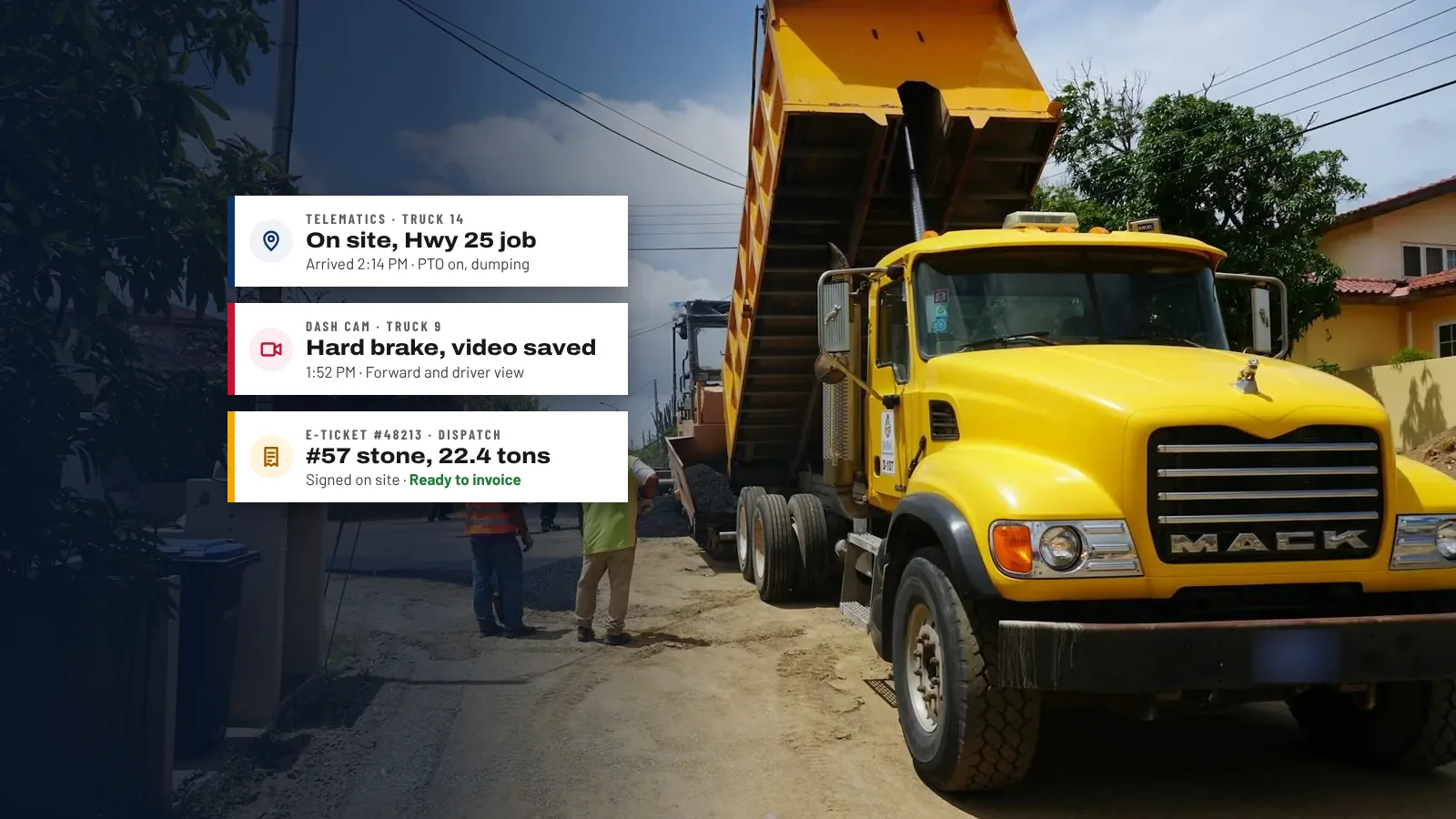
Every fleet technology salesperson will tell you their platform does it all. For a dump, concrete, refuse or utility fleet, that’s rarely the whole story. The software built for long-haul freight was designed around loads, lanes and brokers. Vocational work runs on job sites, scale tickets, tons and hours, and trucks that do their real work with the PTO engaged.
This guide sorts out what each kind of fleet technology actually does, what to buy first when the budget only covers one, and where one-truck owner-operators, small fleets and large fleets each fit. It ends with how the best-known platforms rate with the people who pay for them.
Three kinds of fleet tech, three different questions
Most of the confusion comes from vendors using the same words for different products. It helps to sort them by the question each one answers.
| Kind | Answers | Typical features | Examples |
|---|---|---|---|
| Telematics | Where is the truck, and what is it doing? | GPS tracking, engine faults, idling, PTO use, electronic logs (ELD), equipment trackers | Samsara, Motive, Geotab, Verizon Connect, GPS Insight, Azuga |
| Video telematics (dash cams) | What happened? | Road- and driver-facing cameras, AI alerts, crash video, driver coaching | Samsara, Motive, Geotab GO Focus, Lytx, Netradyne |
| Dispatch, ticketing and fleet management software | What work, for whom, and did we get paid? | Orders, dispatch, e-tickets, timesheets, invoicing, driver pay; or maintenance, inspections and records | Tread, TruckIT, HCSS Dispatcher, Command Alkon, Routeware; Fleetio for maintenance |
“TMS,” short for transportation management system, is the freight industry’s name for the third group. Freight TMS products are built around loads, brokers and lanes. The vocational versions are built around jobs and materials: TruckIT and Tread handle construction hauling dispatch, tickets and billing, Command Alkon’s COMMANDseries runs ready-mix from quote to ticket to invoice, Routeware puts paperless route sheets and service verification in refuse trucks, and HCSS Dispatcher schedules crews, trucks and equipment for heavy civil contractors. (TruckIT, Tread, Command Alkon, Routeware, HCSS)
Maintenance software like Fleetio is a fourth piece some fleets add. It tracks service schedules, work orders, inspections and repair costs, and it can pull mileage and engine hours from your telematics. (Capterra, Fleetio)
When dispatch and ticketing software pays off
No truck count makes software the right call by itself. The signs are in the office, not the yard. Dispatch and ticketing software tends to earn its cost when several of these are true:
- Your dispatcher spends the day on the phone finding out where trucks are and which job needs another load.
- Paper tickets get lost, wet or illegible, and someone spends hours each week matching tickets to jobs.
- Invoices go out days or weeks after the work, because the tickets have to come back to the office first.
- You hire subhaulers or broker trucks and need to track their loads and pay them accurately.
- Driver pay disputes come up because hours and loads aren’t recorded the same way every time.
- Customers, material suppliers or DOT projects are asking for electronic tickets.
The payoff shows up as loads billed that used to slip through, faster invoices and fewer hours spent chasing paper. If none of those problems sound familiar, a shared calendar, a good spreadsheet and your accounting software may be enough for now.
If you can only afford one
Work through it in this order.
1. Start with what the law requires
If your drivers need ELDs, an ELD comes first, and most ELDs today come as part of a telematics system. Many local vocational drivers don’t need one. Drivers who qualify for the short-haul exemption, drivers who need logs on no more than 8 days in any 30, and trucks with engines older than model year 2000 are exempt from the ELD rule. (FMCSA; 49 CFR 395.8) See the short-haul exemption for work trucks to check whether your trucks qualify, and use the free 150 Air-Mile Time Card for the time records short-haul drivers keep instead.
2. Then spend where you lose the most money
Losing money on paper
Dispatch and e-tickets first
- Lost or late tickets
- Slow invoicing
- Subhauler pay and driver pay disputes
- Drivers’ phone apps can show where loads are during the job
Losing money on claims
Dash cams first
- Disputed crashes and cargo claims
- Rising insurance premiums
- New or young drivers to coach
- A stand-alone camera can work without a full telematics plan
Losing money on trucks
Telematics and maintenance first
- Idling and fuel waste
- Missed service and breakdowns
- Equipment theft or unbilled time on site
- Engine fault alerts before a roadside failure
Dash cams can pay off through insurance too, though the numbers vary. Insurer RLI offered Samsara camera users a premium discount of up to 5% in 2020, and insurer HDVI said in 2023 that it averaged about 10% off for fleets using Netradyne cameras. Those are vendor-partner programs, so ask your own agent what your carrier offers before counting on a discount. (HDT; CCJ) For how to set up cameras fairly, see our guide to fleet dash cam privacy.
Is there one system that checks every box?
A few platforms cover most of it. None covers everything a vocational fleet does.
- Samsara combines GPS tracking, ELDs, AI dash cams, maintenance and fault alerts, fuel reporting and equipment trackers, including PTO and utilization reporting for construction equipment. (Samsara)
- Motive combines ELDs, AI dash cams, GPS and asset tracking, maintenance, equipment monitoring and its own fleet card for fuel and spending. (Motive)
- Geotab is a telematics platform with a large marketplace of add-on apps. In 2026 it added the GO Focus Pro, its own AI dash cam built into MyGeotab, alongside the earlier GO Focus models. (Geotab)
What these platforms don’t do in depth is the trade-specific paperwork: material tickets by the ton, job costing, customer billing, ready-mix batching or refuse route verification. For that, most fleets connect their telematics to a dispatch system. TruckIT, for example, lists integrations with Samsara, Motive, Geotab and Verizon Connect, and Routeware lists Geotab and Samsara as partners. (SourceForge; Samsara Marketplace; Routeware)
Should you have both?
Once a fleet has more than a handful of trucks and does its own dispatching, usually yes, as long as the two systems talk to each other. Telematics knows when a truck arrives and when the PTO comes on. Dispatch knows which job and which ticket that load belongs to. Connected, they let the office see loads delivered and billable without a phone call. Disconnected, someone types the same information twice.
Before you sign for either one, ask the vendor to show the integration working with the other system you use, not just a logo on a partner page.
Owner-operators, small fleets and large fleets
One truck
Owner-operators
- Leased to a carrier: the carrier often supplies the ELD and paperwork
- Short-haul and independent: you may not need an ELD; keep time records
- A good dash cam protects you in a crash dispute
- Use the e-ticket app your customers already run, plus simple invoicing
A few trucks to a few dozen
Small fleets
- One telematics and camera platform, so drivers learn one app
- Dispatch and e-tickets once paper slows billing
- Maintenance reminders in the telematics platform or a tool like Fleetio
- Watch contract length: some vendors require three years
Many trucks and yards
Large fleets
- Trade-specific dispatch tied to accounting or ERP
- Telematics chosen for data access and integrations
- Separate maintenance software for multiple shops
- A written driver-data and camera policy
Owner-operators get pitched the same enterprise tools as 500-truck fleets, and they rarely need them. The money usually goes further on reliable equipment, a dash cam and getting paid on time. When you work for a contractor or broker who uses a ticketing app, use theirs; it’s how your loads get counted.
What subscribers say: ratings
These ratings come from G2 and Capterra, two review sites that verify reviewers. Both were checked on Oct 30, 2026. A rating built on thousands of reviews tells you much more than one built on a handful. (G2; Capterra)
| Product | G2 rating (reviews) | Capterra rating (reviews) | What it is |
|---|---|---|---|
| Samsara | 4.5 (5,469) | 4.5 (1,047) | Telematics, ELD, AI dash cams, maintenance, equipment |
| Motive | 4.4 (3,761) | 4.5 (1,689) | Telematics, ELD, AI dash cams, maintenance, fleet card |
| Geotab | 4.4 (248) | 4.4 (100) | Telematics, its own AI dash cams, app marketplace |
| Azuga | 4.7 (207) | 4.3 (302) | Telematics, driver scoring and dash cams |
| GPS Insight | Not listed | 4.5 (245) | Telematics, ELD and driver scorecards |
| Verizon Connect | 3.8 (975) | 3.2 (948) | Telematics and fleet tracking |
| Teletrac Navman | Not listed | 2.7 (46) | Telematics and ELD; many reviews are from 2013 to 2019 |
| Netradyne | 4.5 (78) | 4.2 (39) | AI dash cams |
| Lytx DriveCam | Not listed | 3.9 (33) | Video safety and dash cams |
| Fleetio | 4.6 (214) | 4.7 (247) | Maintenance, inspections and fleet records |
| HCSS | 4.6 (264) | Not listed | Heavy civil software, including dispatch and telematics |
| Tread and TruckIT | Too few | 5.0 (1 review each) | Construction hauling dispatch, tickets and billing |
“Not listed” means the product didn’t appear on that site’s fleet management pages when we checked. Ratings change often; check the current numbers before you buy.
What the reviews have in common
- For Samsara and Motive, reviewers praise easy setup and day-to-day use. Samsara’s most common complaints are technical glitches, billing and contract terms; Motive’s are pricing, contract terms and device connectivity. (Capterra)
- Customer service drives the low scores. It is Verizon Connect’s lowest-rated category on Capterra (2.8), and slow or hard-to-reach support is the most common complaint for Teletrac Navman and Netradyne and a frequent one for Lytx. (Capterra)
- G2 reviewers report about two months to get Samsara or Motive running and about nine months to see a return. For Geotab they report about one month and ten months; for Verizon Connect, about two months and twenty-five months. Average reported discounts off list price ran 8% to 12%. (G2)
- Dump truck dispatch and e-ticketing tools have only a review or two each, so ask those vendors for references from fleets that haul the same materials you do.
Before you sign
- Contract length and exit: how many years, what happens if you sell trucks or close, and what it costs to cancel.
- All-in price per truck: software, hardware, cameras, installation and any per-driver or per-user fees, in writing.
- Integrations, shown working: your dispatch, accounting and maintenance systems.
- Coverage where you work: cell signal at your quarries, landfills and rural job sites.
- A trial on two or three trucks before the whole fleet.
- Driver data and camera policy: who can see video and location, and when. Talk to drivers before installation, not after.
- Your data on the way out: how you export trip, log and ticket records if you switch.
Fleet software FAQ
What is the difference between telematics and fleet management software?
Telematics is the hardware and data that report where a truck is and what it is doing: GPS location, engine data, idling, PTO use and, in many systems, electronic logs. Fleet management software is a wider term for the tools that run the business around the trucks, such as dispatch, job tickets, billing, maintenance and inspections. Many telematics platforms now include some fleet management tools, and many fleet management tools pull in telematics data.
When does dispatch or TMS software make sense for a vocational fleet?
It usually pays off when paper and phone calls start costing money: dispatchers spend the day on the phone, tickets get lost or arrive late, invoices go out days after the work, you use subhaulers, or customers and DOT projects ask for electronic tickets. Those are the signs that a dispatch and ticketing system would earn its cost.
If I can only afford one, should I buy telematics with cameras or dispatch software?
Start with what the law requires. If your drivers need ELDs, an ELD with telematics comes first. If your trucks run under the short-haul exemption and do not need ELDs, put your money where you lose the most: dispatch and e-ticketing if tickets and billing leak money, or dash cams if crash claims and insurance costs are the bigger risk.
Is there one system that does telematics, cameras and dispatch?
Samsara and Motive come closest. Both combine GPS tracking, ELDs, AI dash cams, maintenance and equipment monitoring in one platform, and Motive adds a fleet card. Geotab offers telematics, its own AI dash cams and a large marketplace of add-on apps. For job tickets, material quantities and customer billing, most dump, concrete and refuse fleets still connect their telematics to a trade-specific dispatch system.
Does an owner-operator need telematics or a TMS?
Often not a full system. An owner-operator leased to a carrier often runs the carrier’s ELD and paperwork. An independent dump truck owner-operator working under the short-haul exemption may not need an ELD at all and can keep time records instead. A one-truck operation usually gets more from a good dash cam, simple invoicing software and the e-ticket app its customers already use.
Which fleet management software has the best user reviews?
Samsara and Motive are the only telematics platforms with thousands of reviews on G2 and Capterra, and both rate about 4.4 to 4.5 out of 5. Fleetio, a maintenance platform, rates 4.6 to 4.7. Azuga, Geotab and GPS Insight also score 4.3 or higher. Verizon Connect and Teletrac Navman score lower, with customer service the most common complaint. Ratings change, so check them before you buy.
How much does fleet telematics cost?
Most large vendors do not publish prices. Independent research from Tech.co puts Samsara’s software at about $27 to $33 per vehicle per month, plus hardware, on a three-year minimum contract. AI dash cams usually add to that. Dispatch software pricing varies; TruckIT’s listing starts at $250 a month. Get written quotes that include hardware, cameras, installation and the full contract term.
The right fleet technology is the one that fixes the problem you actually have, whether that’s lost tickets, disputed crashes, idle trucks or missed service. Start there, buy what solves it, and make sure whatever you buy next can connect to it.
Stay in the loop
Join the Crew free for fleet tech and compliance updates, new free tools, and stories from vocational fleets across the country.
Sources (31)
- G2, Best Fleet Management Software: user reviews (October 2026)
- G2, Samsara vs. Verizon Connect
- G2, Motive vs. Verizon Connect
- G2, Motive vs. Samsara
- G2, Geotab vs. Verizon Connect
- Capterra, Samsara reviews
- Capterra, Motive reviews
- Capterra, Geotab reviews
- Capterra, Azuga Fleet reviews
- Capterra, GPS Insight reviews
- Capterra, Verizon Connect reviews
- Capterra, Teletrac Navman DIRECTOR reviews
- Capterra, Fleetio reviews
- Capterra, Netradyne Driver•i reviews
- Capterra, Lytx DriveCam reviews
- Capterra, Tread
- Capterra, TruckIT
- SourceForge, TruckIT: features, integrations and starting price
- BuiltWorlds, Tread company profile
- Samsara, Construction fleet management
- Samsara App Marketplace, TMS and dispatch apps
- Motive, Fleet management products
- Geotab, GO Focus Pro AI dash cam (Feb. 11, 2026)
- HCSS, Dispatcher
- Command Alkon, COMMANDseries
- Routeware, On-board computers for waste collection
- Tech.co, Samsara fleet management review (updated Sept. 7, 2026)
- CCJ, AI-enabled dashcams can help fleets reduce insurance costs (Apr. 2023)
- HDT Trucking Info, RLI offers fleet customers up to 5% insurance discount with Samsara cameras (Feb. 2020)
- FMCSA, Who is exempt from the ELD rule?
- 49 CFR 395.8, Driver’s record of duty status
Ratings, features and prices were checked against each source on Oct 30, 2026 and change often. VTA sells advertising to fleet technology companies; no company paid for, reviewed or approved this article, and VTA earns nothing if you buy any product named here. General information, not legal or insurance advice. See something out of date? Send a correction