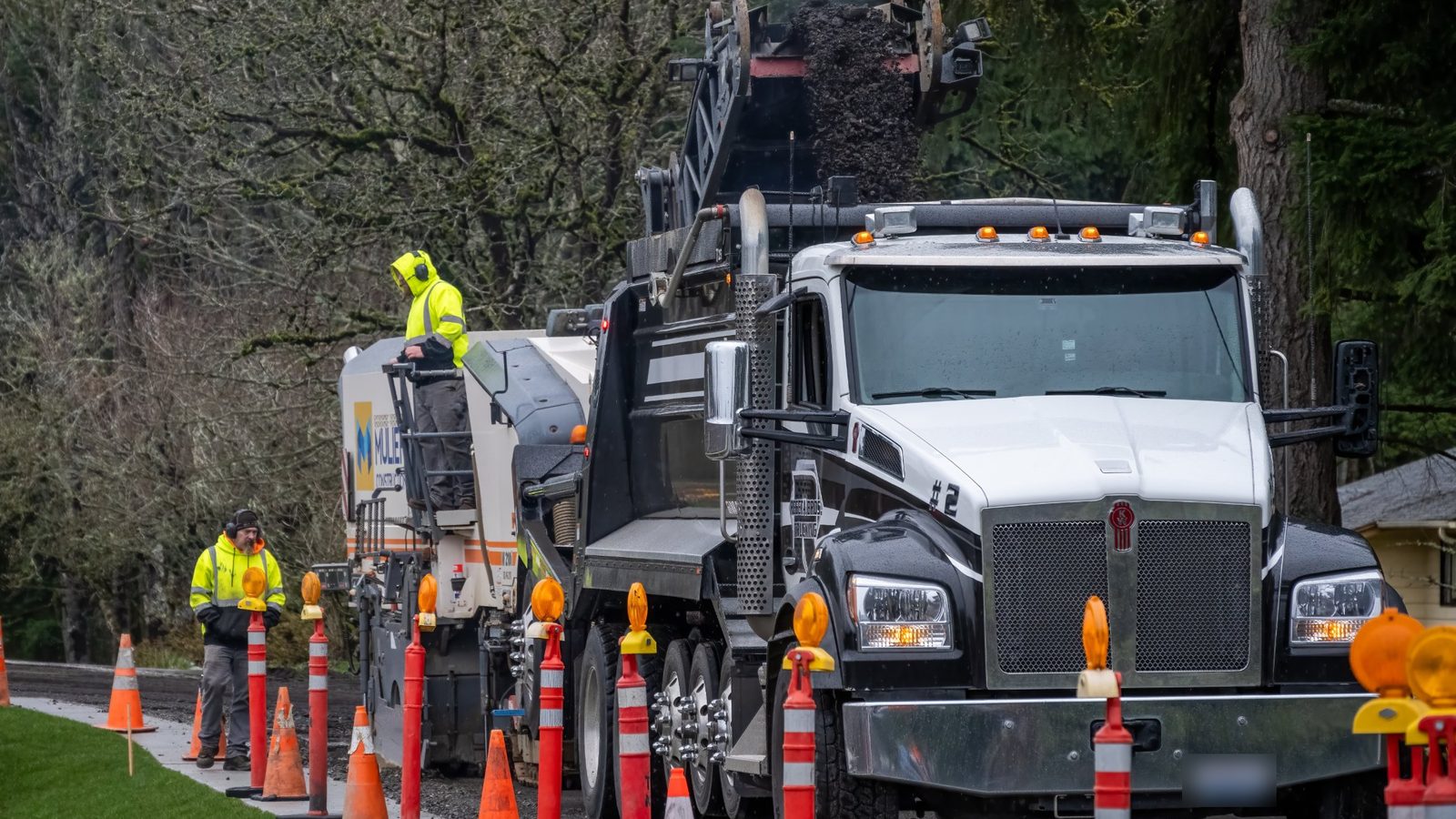
The trucks
Most construction hauling is done by Class 8 straight dump trucks, backed up by tractor-trailer dumps for bigger volumes and roll-offs for debris.
| Truck | What it does | Typical setup |
|---|---|---|
| Tandem-axle dump | The everyday hauler for gravel, fill, sand and asphalt on local jobs | Straight truck, two rear drive axles, steel or aluminum body |
| Tri-axle or quad-axle dump | Heavier loads where state weight laws allow | Tandem drive plus lift (pusher) axles lowered when loaded |
| Dump with trailing axle | Payload closer to a tractor-trailer while staying a straight truck | Hydraulic trailing axle deploys behind the body |
| Transfer dump | Doubles a straight truck's load with a second box | Trailer box rolls into the truck body to unload |
| End-dump tractor-trailer | Large volumes on open sites and highway projects | Tractor plus a tipping trailer |
| Belly (bottom) dump | Spreads aggregate in rows while moving, for road base | Tractor plus a bottom-discharge trailer |
| Roll-off | Drops and picks up open-top containers for demolition debris | Cable or hook hoist on a straight truck |
The people and the jobs
A dump truck crew is a driver, the operator who loads the truck and the mechanic who keeps it running. All three jobs pay close to $60,000 and are projected to grow 4% from 2025 to 2035.
First-time Class A or B applicants must finish entry-level driver training with a provider on FMCSA's Training Provider Registry before the skills test. Most truck-driving programs run 3 to 6 months. Pay: BLS, May 2025.
Safety on the job
The biggest dangers are backovers, tip-overs and contact with overhead power lines. These controls come from NIOSH's 2023 dump truck guidance.
- Backing: use a trained spotter with clear sight lines and agreed signals, and keep ground crews out of blind spots behind the truck, at the front bumper and on the passenger side.
- Tip-overs: dump on firm, level ground, keep loads even, watch slopes and high wind, and always wear a seat belt.
- Power lines: dump well away from lines and never drive with the bed raised. If the truck touches a line, stay in the cab and call 911.
- Under the bed: brace a raised body and use lockout/tagout before any maintenance.
- Weight rules: federal Interstate limits are 80,000 lb gross, 20,000 lb on a single axle and 34,000 lb on a tandem; the Bridge Formula can lower the gross limit.
Material containment
Keep the load in the box
Dirt, sand, gravel and asphalt that blow or fall from a dump truck break federal law, chip windshields and cause crashes. Under 49 CFR 393.100(b), cargo must not leak, spill, blow or fall from the truck, and most states add covered-load laws.
- Tarp every load: even where state freeboard rules allow an open box. Highway wind lifts fines and small stones.
- Load below the sideboards: heaped loads shed material in turns and over bumps.
- Seal the tailgate: keep gaskets and latches tight so wet material and fines don't leak.
- Clean off carryback: knock material off the tailgate, frame rails and bumper before leaving the site.
- Check the tarp system: inspect the tarp, arms and motor at every pre-trip. A torn tarp is no tarp.
| Consequence | Amount or effect |
|---|---|
| Federal penalty, carrier | Up to $19,246 per violation (49 CFR 386, App. B; adjusted for inflation each year) |
| Federal penalty, driver | Up to $4,812 per violation |
| State fines | $10 to $5,000 depending on the state; at least 16 states also allow jail time |
| CSA score | 49 CFR 393.100(b) (leaking, spilling, blowing or falling cargo) carries severity weight 7, in the Vehicle Maintenance BASIC and on the driver's record |
| Time in the score | 24 months: 3x for the first 6 months, 2x to 12 months, then 1x; +2 if placed out of service. One recent spill = 21 points, as much as seven minor securement violations |
FMCSA is revising CSA scoring, including a simpler 1–2 severity scale; check the current method. General information, not legal advice. Sources: 49 CFR 393.100, 49 CFR 386 App. B, J. J. Keller, AAA state survey, AAA. DOT Compliance Center →
Fleet buyer spec checklist
Spec the truck around the heaviest legal load in your state, not the body size.
Resource kit
Construction & Dump resource kit
Toolbox talks for your next crew meeting, the rules that apply most and the associations that train and represent the trade.
Toolbox talks
Links go to official and association sites. More: DOT Compliance Center · Buyer’s Guide · Parts & Maintenance
Construction & Dump FAQ
What CDL do I need to drive a dump truck?
Most straight tandem and tri-axle dump trucks are rated over 26,000 lb GVWR and need a Class B CDL. Transfer dumps, belly dumps and other combinations need a Class A.
What is the federal weight limit for a dump truck?
On the Interstate system, 80,000 lb gross, 20,000 lb on a single axle and 34,000 lb on a tandem axle. The Bridge Formula can lower the gross limit, and many states allow more on state roads with permits or extra axles.
Do dump trucks have to be tarped?
Federal rules require that cargo not leak, spill, blow or fall from the truck (49 CFR 393.100(b)), and most states have covered-load laws. Tarping every load is the safest practice.
For truck manufacturers, dealers and upfitters
Reach this industry
Construction is the biggest vocational buyer. Global Market Insights estimates North America's vocational truck market at about $22 billion in 2025, growing about 7.5% a year to 2035.
- Sponsor this guide and its driver stories.
- List dealers and body builders by region in Find a Dealer and Spec & Upfit.
- Host ride-and-drives and hiring events with local contractors and aggregate producers.
- Use the Proud Partner badge on spec sheets and at trade shows.
Sources
- BLS: Construction industry employment
- BLS OOH: Heavy and tractor-trailer truck drivers
- BLS OOH: Construction equipment operators
- BLS OOH: Diesel service technicians and mechanics
- FMCSA: CDL classes and entry-level driver training
- NIOSH: Preventing Dump Truck-related Injuries and Deaths (2023)
- FHWA: Bridge Formula Weights
- Global Market Insights: Vocational truck market