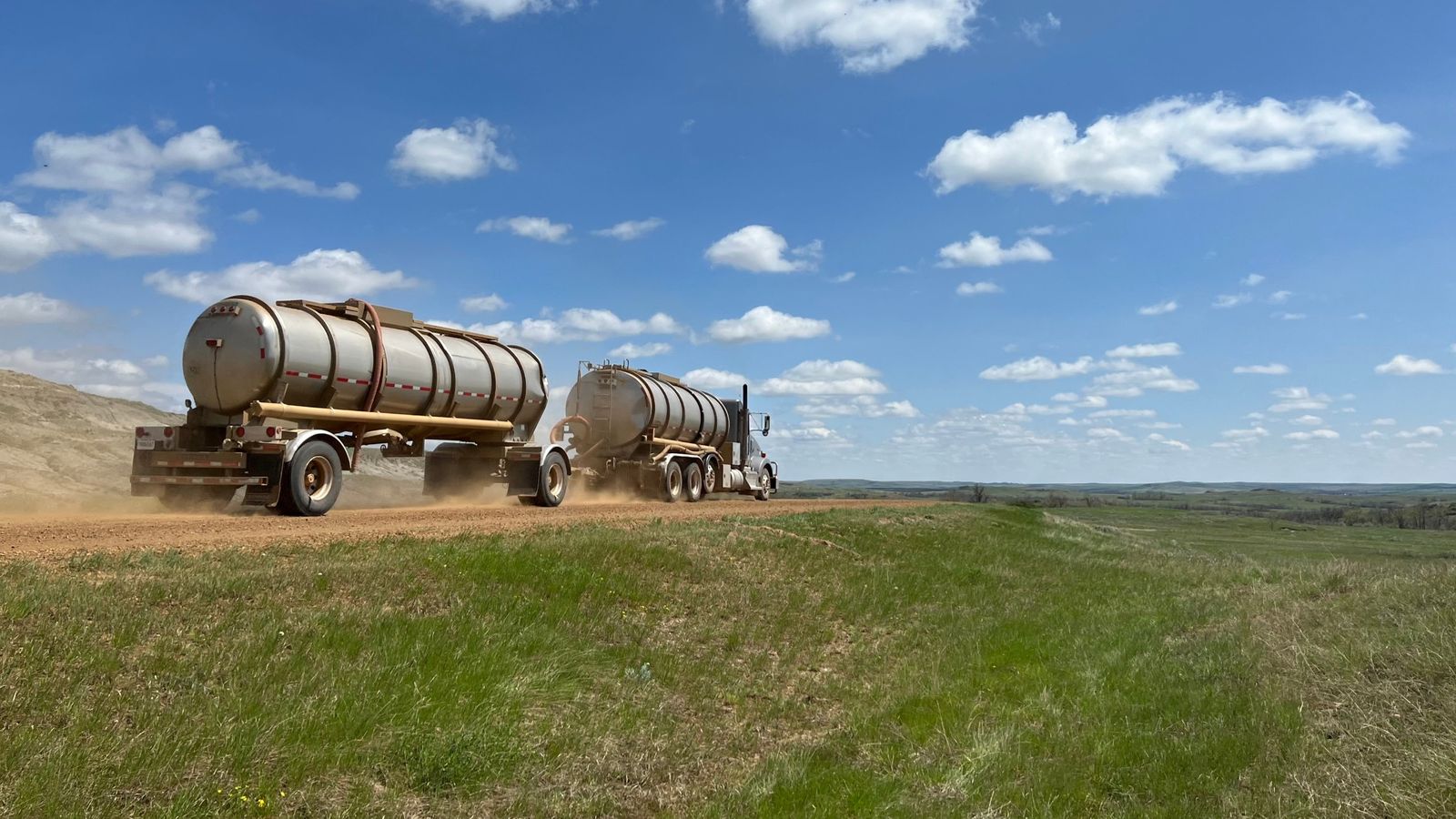
The trucks
Oilfield and mining trucks are the heaviest-spec vocational trucks on the road, built for lease roads, mud and constant loads.
| Truck | What it does | Typical setup |
|---|---|---|
| Winch truck | Moves rig parts, pipe and heavy equipment | Heavy tandem or tridem with a big tail winch and roll-up bed |
| Bed truck | Hauls and loads rig substructures | Tilting or roll-off bed with winches |
| Frac sand hauler | Delivers proppant sand to well sites | Tractor plus pneumatic or bottom-dump trailer |
| Vacuum truck | Removes drilling mud, produced water and spills | Vacuum pump and tank, often a tractor-trailer |
| Water truck | Water for drilling, fracking and dust control at mines | Straight truck or tractor with tank and spray bars |
| Fuel and acid tankers | Supply diesel and well-treatment chemicals | Hazmat-rated tank trailers |
| Well service units | Coil tubing, wireline and nitrogen pumping | Purpose-built units on heavy carrier chassis |
| Fuel and lube service truck | Fuels and greases equipment at mines, quarries and job sites | Straight truck with fuel, oil and grease tanks, reels and pumps |
| Propane delivery truck (bobtail) | Delivers propane to homes, farms and businesses | Straight truck with pressure tank and meter; CDL with hazmat and tank endorsements |
The people and the jobs
Energy work pays well and follows the price of oil, with busy booms and slow downturns. Many jobs mean long rotations away from home.
Driver pay is for all heavy truck drivers (May 2025); roustabout and operator pay are for the mining, oil and gas industry (2025). A hazmat endorsement needs an extra knowledge test and background check. Source: BLS.
Safety on the job
The road is the biggest killer in oil and gas. From 2003 to 2009, oil and gas extraction workers' motor-vehicle fatality rate was 8.5 times that of all private-sector workers, and seatbelt non-use was a factor in 38.1% of those deaths (NIOSH).
- Seat belts, every trip: the simplest fix for the leading cause of death.
- Fatigue: long shifts and long rural drives, so manage hours and plan journeys.
- Lone workers: about 21% of oil and gas deaths from 2014 to 2019 involved someone working alone, so use check-in procedures.
- Rig moves: plan winch and load paths, and keep crews clear of cables under tension.
- Mines and quarries: follow site haul-road rules, berms and right-of-way for large equipment.
Fleet buyer spec checklist
Oilfield and mining trucks live off pavement. Spec for traction, cooling and heavy, uneven loads.
Resource kit
Energy, Oil & Mining resource kit
Toolbox talks for your next crew meeting, the rules that apply most and the associations that train and represent the trade.
Toolbox talks
Links go to official and association sites. More: DOT Compliance Center · Buyer’s Guide · Parts & Maintenance
Energy, Oil & Mining FAQ
What is a winch truck?
A heavy oilfield truck with a large tail winch and roll-up bed, used to move rig parts, pipe and equipment.
What hours-of-service rules apply in the oilfield?
Oilfield operations have special provisions: waiting time at a well site can be recorded as off duty in some cases, and a 24-hour restart is available. Confirm the details with FMCSA.
Do oilfield truck drivers need a hazmat endorsement?
Drivers hauling fuel, acids or other hazardous materials need the hazmat (H) endorsement, and liquid tankers also need the tank (N) endorsement.
For truck manufacturers, dealers and upfitters
Reach this industry
Global Market Insights estimates mining as a $16.7 billion vocational truck application worldwide in 2025, reaching $30.7 billion by 2035. Buyers value service networks that stay in the basins through the cycle.
- Sponsor this guide and road-safety campaigns for oilfield drivers.
- Feature winch, tank and well-service builders in Spec & Upfit.
- List dealers and service points by basin and region.
- Use the Proud Partner badge at energy and mining shows.
Sources
- BLS: Mining, quarrying, and oil and gas extraction
- BLS: Oil and gas extraction
- CDC MMWR: Fatalities in the oil and gas extraction industry, 2014–2019 (2023)
- NIOSH: Motor vehicle fatalities in oil and gas extraction, 2003–2009 (2013)
- NIOSH: Motor vehicle fatalities among oil and gas workers (2013)
- Global Market Insights: Vocational truck market