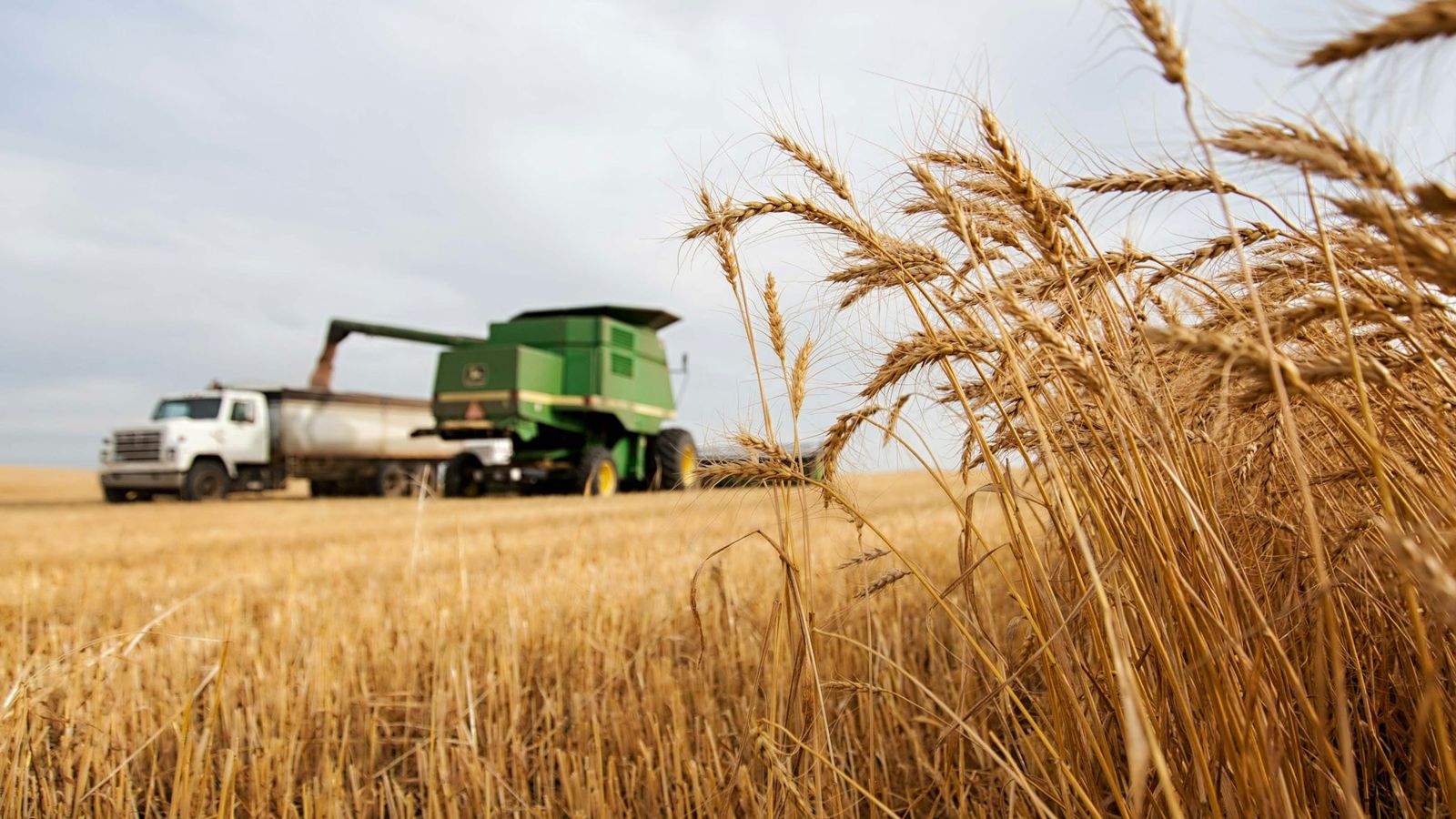
The trucks
Farm trucks follow the season: grain at harvest, seed and fertilizer at planting, and feed, livestock and milk all year.
| Truck | What it does | Typical setup |
|---|---|---|
| Grain truck | Hauls grain from the combine to bins, elevators and ethanol plants | Tandem or tri-axle straight truck, grain body, roll tarp and hoist |
| Hopper-bottom semi | Longer grain hauls to elevators, mills and river terminals | Day-cab tractor and hopper-bottom trailer; CDL Class A off the farm |
| Bulk feed truck | Delivers feed to poultry, hog and dairy farms | Compartmented body with unloading auger |
| Fertilizer and spreader truck | Applies dry or liquid fertilizer, lime and manure | High-flotation tires with a spinner or boom applicator |
| Livestock hauler | Moves cattle and hogs to farms, sale barns and packers | Tractor with a ventilated pot-belly or straight-deck trailer |
| Milk tanker | Picks up milk at dairies for processing plants | Insulated stainless tank with pump, on a tractor or straight truck |
The people and the jobs
Many farm truck drivers are the farmers themselves, family members or seasonal help at harvest. Co-ops, elevators, feed mills, dairies and custom harvesters hire full-time drivers.
Pay is the U.S. median, May 2025. Agricultural worker pay covers all agricultural workers; truck driver pay covers all industries. Source: BLS.
Safety on the job
Agriculture, forestry, fishing and hunting had 20.9 deaths per 100,000 workers in 2024, more than six times the all-worker rate of 3.3. Transportation incidents were the leading cause.
- Harvest fatigue: long days and night hauling cause crashes. Plan rest, rotate drivers and take extra care on rural roads at dusk.
- Rural roads: soft shoulders, narrow bridges and weight-posted roads. Know the route, the bridge limits and where the slow farm equipment is.
- Grain bins: never enter a bin while grain is moving or unloading equipment is running. Engulfment can happen in seconds.
- Livestock: load calmly and stay clear of kicks and crush points in alleys and trailers.
- Know your exemptions: covered farm vehicles can be exempt from CDL, medical card, drug testing and hours-of-service rules, though trucks over 26,001 lb keep it outside their home state only within 150 air miles of the farm. The exemptions don't cover for-hire hauling.
Material containment
Keep the grain in the box
Grain, seed and dry fertilizer blowing from an uncovered truck crack windshields, litter roads and can bring citations. Under 49 CFR 393.100(b), cargo must not leak, spill, blow or fall from the truck, and many states require loads to be covered.
- Tarp every road load: roll the tarp before leaving the field, even for short trips to the elevator.
- Seal the gates: check end gates and hopper slides so grain doesn't leak on the road.
- Don't heap it: keep the load below the sides so it doesn't shed in turns.
- Sweep the rails: brush grain off frame rails, fenders and the top of the box before driving.
- Check the tarp system: inspect the tarp, arms and crank or motor at every pre-trip.
| Consequence | Amount or effect |
|---|---|
| Federal penalty, carrier | Up to $19,246 per violation (49 CFR 386, App. B; adjusted for inflation each year) |
| Federal penalty, driver | Up to $4,812 per violation |
| State fines | $10 to $5,000 depending on the state; at least 16 states also allow jail time |
| CSA score | 49 CFR 393.100(b) (leaking, spilling, blowing or falling cargo) carries severity weight 7, in the Vehicle Maintenance BASIC and on the driver's record |
| Time in the score | 24 months: 3x for the first 6 months, 2x to 12 months, then 1x; +2 if placed out of service. One recent spill = 21 points, as much as seven minor securement violations |
FMCSA is revising CSA scoring, including a simpler 1–2 severity scale; check the current method. General information, not legal advice. Sources: 49 CFR 393.100, 49 CFR 386 App. B, J. J. Keller, AAA state survey, AAA. DOT Compliance Center →
Fleet buyer spec checklist
Spec for the busiest week of the year: harvest volume, distance to the elevator and the roads in between.
Resource kit
Agriculture & Farm resource kit
Toolbox talks for your next crew meeting, the rules that apply most and the associations that train and represent the trade.
Toolbox talks
Links go to official and association sites. More: DOT Compliance Center · Buyer’s Guide · Parts & Maintenance
Agriculture & Farm FAQ
Do farmers need a CDL to drive a grain truck?
Not always. A covered farm vehicle, driven by the farmer, family or employees and hauling the farm’s own products, can be exempt from the CDL. Trucks over 26,001 lb keep the exemption anywhere in their home state, but only within 150 air miles of the farm when they cross state lines.
What is a covered farm vehicle?
A farm-registered truck operated by the farm, hauling agricultural commodities, livestock, machinery or supplies, and not used for hire.
Do grain trucks need tarps?
Federal rules require that loads not spill or blow from the truck, and many states require covered loads. A roll tarp on every road load is the safest practice.
For truck manufacturers, dealers and upfitters
Reach this industry
Farms buy new and used trucks, and many run them only part of the year. Reliability, resale value and rural dealer service matter most.
- Sponsor this guide and harvest safety stories.
- Feature grain-body, feed-body and spreader builders in Spec & Upfit.
- Back harvest-season rural road safety campaigns.
- Use the Proud Partner badge at farm shows.
Sources
- USDA NASS: Farms and Land in Farms 2025 (Feb. 2026)
- BLS OOH: Farmers, ranchers and other agricultural managers
- BLS OOH: Agricultural workers
- BLS CFOI: Fatal work injuries by industry (2024)
- NIOSH: Agricultural safety
- Heavy Vehicle Inspection: Farm vehicle FMCSA exemptions
- BLS OOH: Heavy and tractor-trailer truck drivers