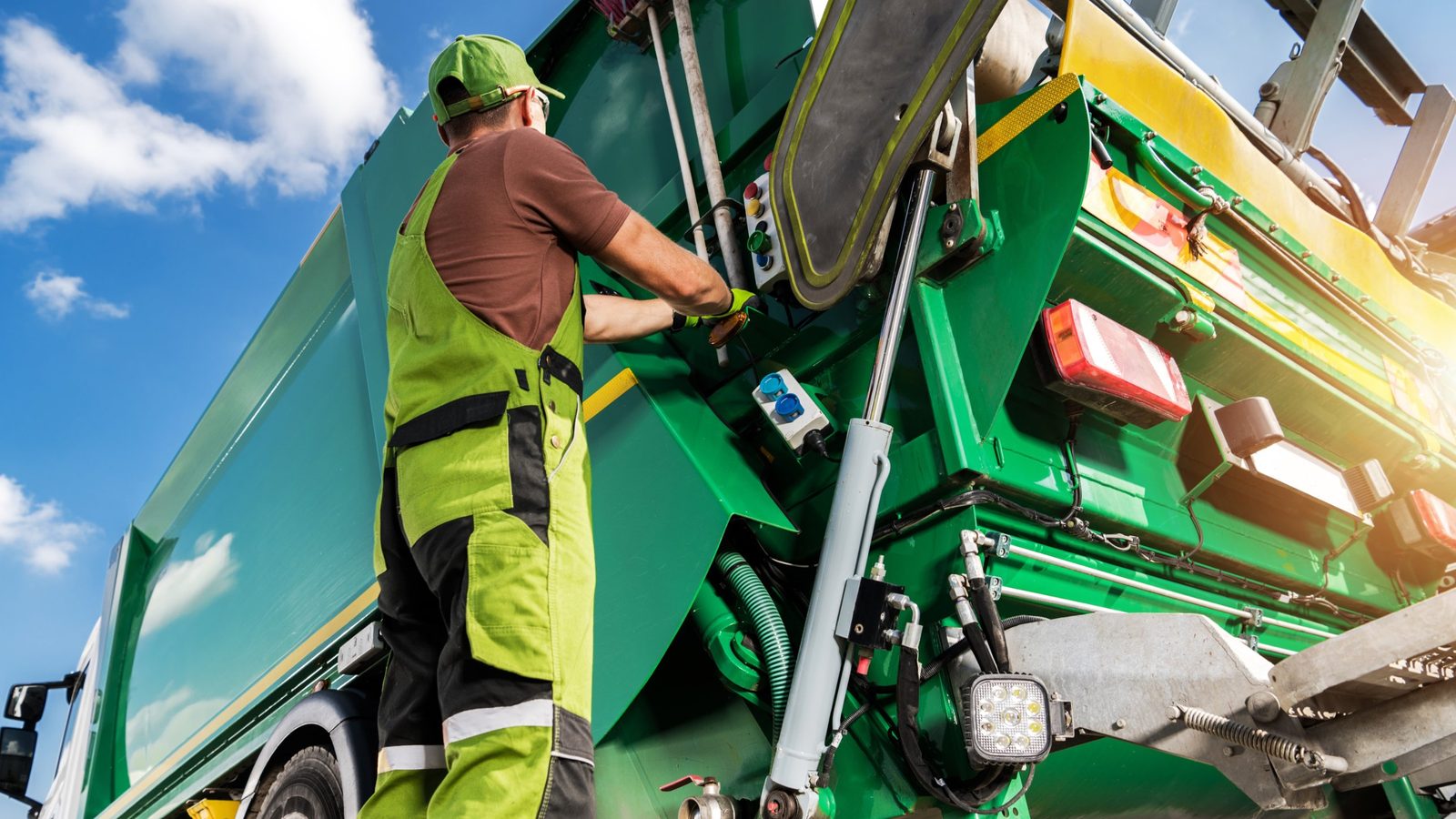
The trucks
The body type follows the route. Homes, businesses and construction sites each need a different truck.
| Truck | What it does | Typical setup |
|---|---|---|
| Automated side loader | One-person residential routes; an arm grabs the cart | Cab-over chassis, often right-hand drive, automated arm |
| Rear loader | Residential and bulky waste where carts or bags vary | Crew loads a rear hopper; packer blade compacts |
| Front loader | Commercial dumpsters at businesses and apartments | Forks over the cab lift containers into the body |
| Roll-off | Large open-top containers for construction and cleanouts | Cable or hook hoist on a straight truck |
| Grapple truck | Bulky items, yard waste and storm debris | Knuckle-boom grapple with a dump body |
| Recycling truck | Separate or dual-stream recycling pickups | Side or rear loader, sometimes split bodies |
The people and the jobs
Refuse work offers steady, local, home-every-night jobs with early starts. Automation is shifting many routes from a three-person crew to one driver-operator.
Collector and driver pay are for the waste management industry (2025); diesel technician pay is for all industries (May 2025). Source: BLS.
Safety on the job
Collectors had a fatality rate of 37.4 per 100,000 workers in 2024, the fifth-highest of any U.S. occupation. Being struck by passing traffic is a leading risk.
- Slow Down to Get Around: state laws that make drivers slow down and move over for collection trucks. Maryland became the 18th state with one in 2018, and more states have followed.
- Automation: side-loader arms keep workers off the street and away from lifting injuries.
- Backing: cameras, sensors and route planning that avoids backing wherever possible.
- Lockout: lock out packers and arms before anyone reaches into the body or hopper.
- Riding steps: follow manufacturer and state rules on riding steps and speed limits.
Material containment
No leaks, no litter
Trash that blows off a truck and liquid that leaks from a packer body are federal violations, roadside hazards and a fast way to lose a city contract. Under 49 CFR 393.100(b), cargo must not leak, spill, blow or fall from the truck.
- Maintain tailgate seals: worn packer seals leak leachate onto streets and driveways.
- Net or tarp roll-offs: cover open-top containers before they leave the site.
- Close the lids: keep front-load and side-load container lids shut, and don't overfill the hopper.
- Watch recycling loads: paper and plastic blow easily; cover and compact before highway runs.
- Clean up at the curb: pick up spills on the route and report hydraulic leaks the same day.
| Consequence | Amount or effect |
|---|---|
| Federal penalty, carrier | Up to $19,246 per violation (49 CFR 386, App. B; adjusted for inflation each year) |
| Federal penalty, driver | Up to $4,812 per violation |
| State fines | $10 to $5,000 depending on the state; at least 16 states also allow jail time |
| CSA score | 49 CFR 393.100(b) (leaking, spilling, blowing or falling cargo) carries severity weight 7, in the Vehicle Maintenance BASIC and on the driver's record |
| Time in the score | 24 months: 3x for the first 6 months, 2x to 12 months, then 1x; +2 if placed out of service. One recent spill = 21 points, as much as seven minor securement violations |
FMCSA is revising CSA scoring, including a simpler 1–2 severity scale; check the current method. General information, not legal advice. Sources: 49 CFR 393.100, 49 CFR 386 App. B, J. J. Keller, AAA state survey, AAA. DOT Compliance Center →
Fleet buyer spec checklist
Start with the route: stops per day, cart type, street width and miles to the landfill or transfer station.
Resource kit
Refuse & Recycling resource kit
Toolbox talks for your next crew meeting, the rules that apply most and the associations that train and represent the trade.
Toolbox talks
Links go to official and association sites. More: DOT Compliance Center · Buyer’s Guide · Parts & Maintenance
Refuse & Recycling FAQ
What types of garbage trucks are there?
Side loaders for automated residential routes, rear loaders, front loaders for commercial dumpsters, roll-offs for large containers, grapple trucks for bulky waste, and recycling trucks.
Is refuse collection a dangerous job?
Yes. Refuse and recyclable material collectors had a fatality rate of 37.4 per 100,000 workers in 2024, the fifth-highest of any U.S. occupation.
What are Slow Down to Get Around laws?
State laws that require drivers to slow down and move over when passing refuse and recycling trucks on their routes.
For truck manufacturers, dealers and upfitters
Reach this industry
Global Market Insights estimates waste management as a $12.6 billion vocational truck application worldwide in 2025, reaching $22.8 billion by 2035. Large haulers are now ordering electric refuse trucks.
- Sponsor this guide and collector safety stories.
- Back Slow Down to Get Around awareness campaigns.
- Feature refuse body builders and alternative-fuel specialists in Spec & Upfit.
- Use the Proud Partner badge at waste industry trade shows.